Most dogs eat perfectly well from a bowl on the floor, and a raised feeder is a fix for specific problems rather than a default upgrade. Before you buy a stand—or order a custom one with your kennel name on the side—it helps to know which dogs actually gain something, which dogs are better left at ground level, and how to land on a height that fits the animal in front of you instead of a marketing category.
Who genuinely benefits from a raised bowl
The strongest case for elevation is a dog that finds lowering its head to the floor painful or awkward. Dogs with arthritis in the neck or forelimbs, dogs recovering from cervical-spine surgery, and many older dogs with general stiffness eat more comfortably when the bowl comes up to meet them. Very tall dogs can also splay their front legs and crane down in a way that looks ergonomically miserable, and a modest lift removes that. A useful test is to watch your own dog eat: one that carries each mouthful a few feet away, repositions repeatedly, or stands with stiff or trembling front legs at the bowl is a candidate, while a young, sound dog that cleans the bowl in one go is not.
There is a separate, medical use case that people sometimes confuse with a raised bowl: megaesophagus. Dogs with that condition need to eat in a near-vertical posture and hold it for several minutes afterward, which is what a purpose-built upright feeding chair provides. A standard elevated bowl on a short stand is not the same thing and will not do that job, so if a vet has raised megaesophagus, ask specifically about vertical feeding rather than assuming any raised feeder qualifies.
The bloat question for deep-chested breeds
Raised feeders are frequently marketed as a way to prevent bloat, and the evidence points the other way for the dogs most at risk. A 2000 study in the Journal of the American Veterinary Medical Association looking at gastric dilatation-volvulus in large and giant breeds found that feeding from a raised bowl was associated with an increased likelihood of the condition, not a reduced one. The study identified other, stronger contributors as well, and the mechanism is not fully settled—one theory is that eating with the head up encourages a dog to swallow more air—but the practical takeaway is clear enough. For a deep-chested giant such as a Great Dane, Mastiff, or Weimaraner, elevation is not a bloat safeguard and may cut the wrong way, so that decision belongs with your veterinarian rather than a product page.
For the large majority of dogs, who are not in a high-risk bloat category and have no orthopedic reason to be lifted, a clean bowl on the floor remains the sensible default. Raising it buys nothing and simply adds a piece of furniture to trip over.
Getting the height right
When elevation does make sense, height is the whole game, and it is easy to get wrong by buying to a size label instead of to the dog. The goal is for the dog to eat with its neck close to level—neither reaching up nor folding down—which puts the rim of the bowl at roughly the height of the lower chest, just below the point of the elbow.
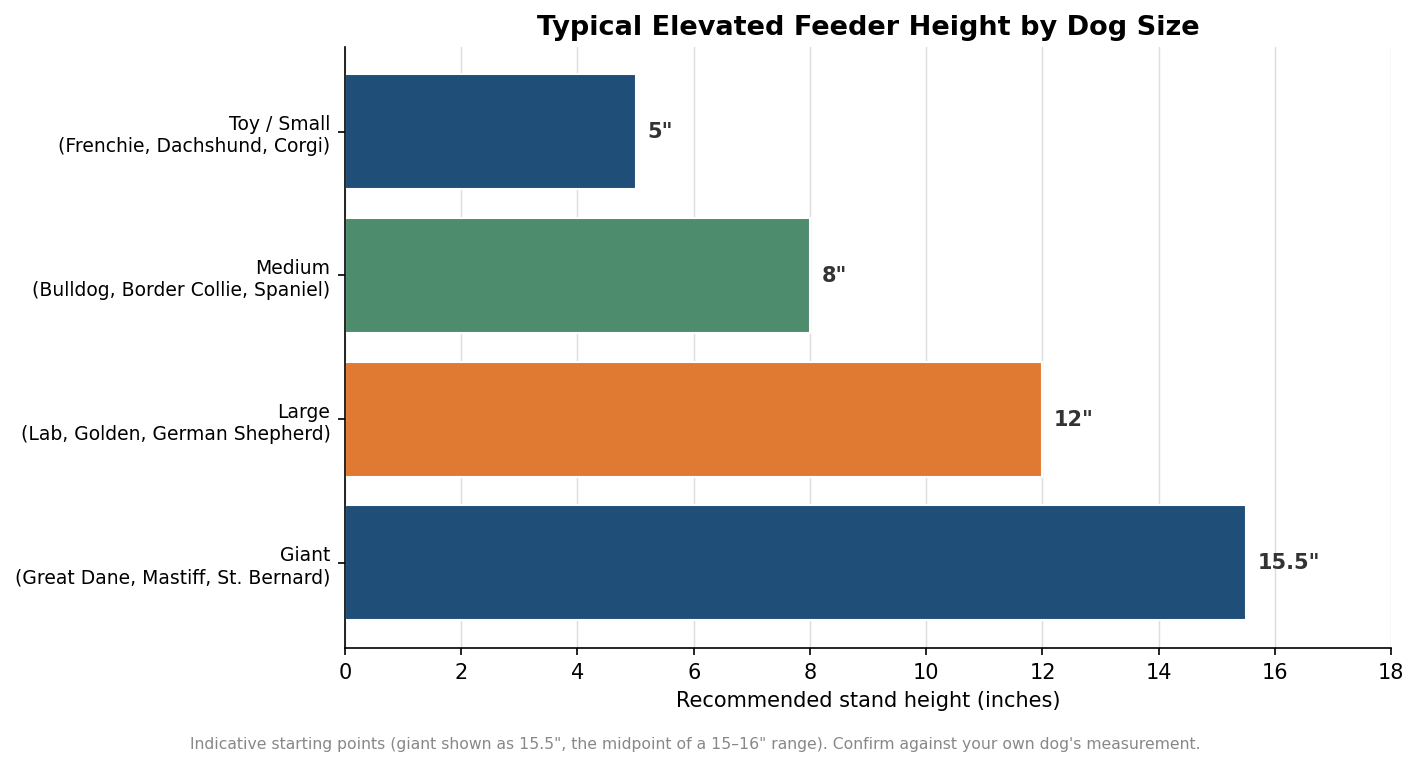
The size bands above are a reasonable starting point: around five inches of stand for toy and small dogs, eight for mediums, twelve for most large breeds, and fifteen to sixteen for giants. Treat them as the opening bid, not the answer, because two Labradors can differ by a couple of inches and a stand that is right for one will be wrong for the other.
Measure the dog before you order. Stand the dog square, measure from the floor to the base of the chest where it meets the front legs, and then subtract the depth of the bowl itself—usually two to four inches—so that the food surface, not the rim, ends up at a comfortable level. The relationship is simple enough to read straight off a chart.
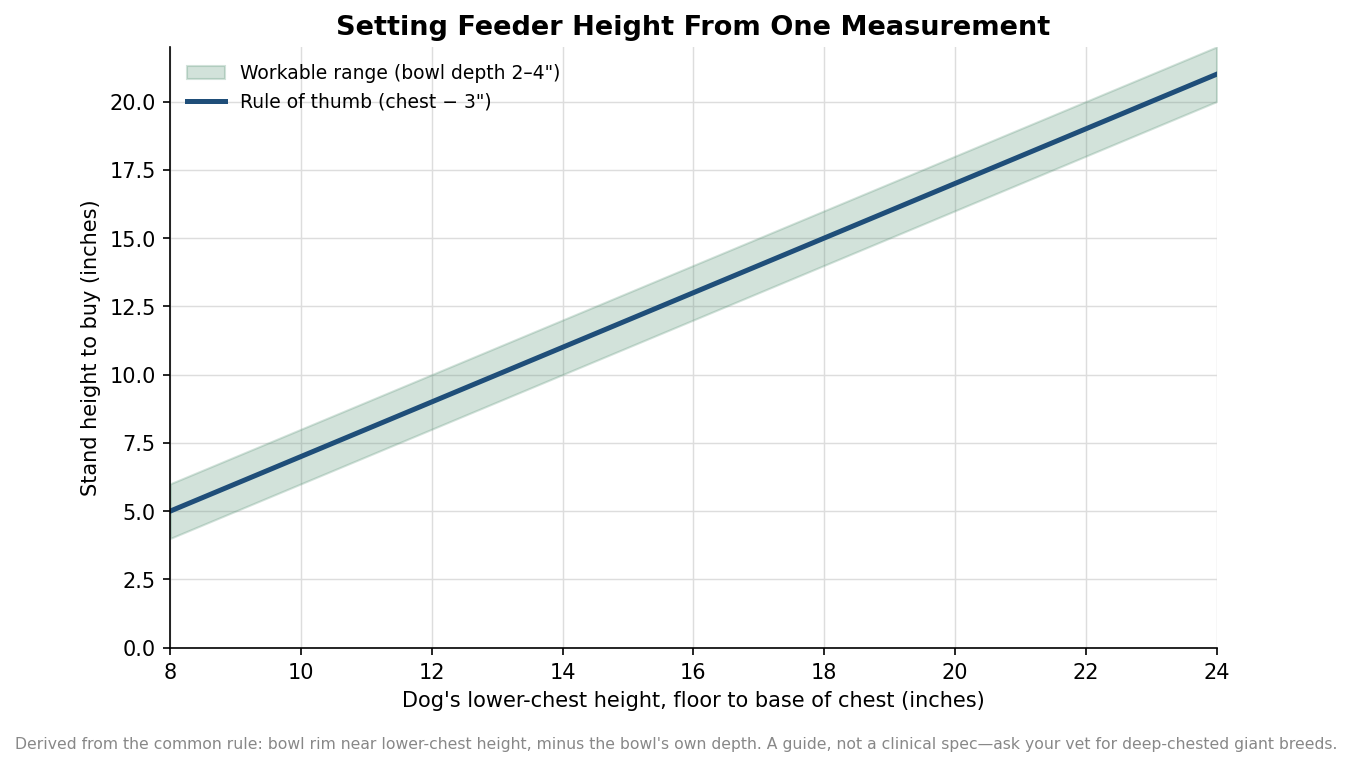
The shaded band shows how bowl depth changes the answer: a shallow saucer-style dish needs a taller stand than a deep bucket-style bowl for the same dog. If your measurement lands between two available stand heights, size down rather than up, since a bowl that is slightly too low is far more forgiving than one that forces the dog to reach.
Stand material, stability, and where the printing goes
A raised bowl only works if it stays put. Enthusiastic eaters push a feeder across the floor, so weight and footing matter more than they do for a floor bowl: a wider base, rubber feet, and a snug seat that keeps the bowl from lifting out all earn their keep. Powder-coated steel and sealed hardwood both hold up well in a feeding station that gets wiped down daily; raw or unsealed wood is the one to avoid, because it wicks water at the seams and eventually swells.
If you are personalizing a stand—a dog’s name, a breeder’s mark, a rescue’s logo—keep the decoration on the exterior of the frame or the outside wall of the bowl, well clear of the food-contact surface. That keeps the artwork away from where the dog eats and away from daily scrubbing, which is where printed and engraved detail tends to wear first. Start with the 12-bowl minimum and live with the first stand for a week before committing to a larger batch; height that looked right on paper occasionally feels off once the dog is actually standing at it, and it is much cheaper to adjust a small first run than a shelf full of stands.